Children First Family Law - Transforming how families navigate the challenging landscape of divorce.
Welcome to *Children First Family Law*, a podcast dedicated to transforming the way families navigate the challenging landscape of divorce. In an industry too often focused on litigation, financial battles, and a war-like approach, we advocate for a radical shift in priorities—putting the well-being of children at the forefront. Join us as we explore how to handle divorce in a way that protects children from the collateral damage of parental conflict and legal battles. We offer resources, insights, and expert advice to help parents understand how to manage divorce without destroying their children’s future. By highlighting the flaws in the current system and providing a roadmap for a more compassionate approach, we aim to become thought leaders in this space, calling for change within the professional landscape of family law. We’ll discuss crucial topics like collaborative and amicable divorce, parental alienation, and navigating the complexities of domestic violence and child abuse within the legal system. Through candid conversations and expert guidance, *Children First Family Law* equips families to emerge from the brokenness of divorce with their children’s well-being intact—just like a beautiful stained glass window crafted from shattered pieces. If you’re asking yourself, ”How can I ensure my children aren’t destroyed by my divorce?” or ”Why does my lawyer always push for litigation?” this podcast is for you. Tune in, and let us guide you toward a healthier, more hopeful future for your family.
Listen on:







Episodes

Monday Aug 11, 2025
Monday Aug 11, 2025
In today’s episode of Children First Family Law, Krista welcomes retired New York Judge, Peggy Walsh, who brings decades of experience from both the Family and Supreme Courts. Judge Walsh unpacks how New York’s family law system centers children’s voices in custody cases and what the rest of the country can learn from it.
Krista and Judge Walsh explore how attorneys for children play an active role in advocating for a child’s stated preferences, even when they differ from best interest arguments. They also compare New York’s court structure with Colorado’s, explore trauma-informed judicial practices, and reflect on how systems either empower or silence young voices. Judge Walsh shares how she approached in-camera interviews with children and how her bench experience now informs her work as a coach for co-parents navigating conflict.
When a child tells their attorney what they want, that’s not just testimony. It’s a window into what makes sense for that child’s life.
In this episode, you will hear:
Child attorneys in New York reflect what the child wants, not what adults believe is best
Best interest and expressed interest often overlap, but not always
New York courts offer every child legal representation at no cost
Judges rely on in-camera interviews to hear from children directly
Ethical representation includes guiding children without overriding them
Professionalism in family court matters more than persuasion
Trauma-informed courts reduce harm during high-conflict litigation
Courts trust parents to decide, and judges step in only when needed
Kids in the middle of conflict often show internal distress
Co-parenting coaching offers an alternative to repeated litigation
Resources from this Episode
peggywalsh.com
thecoparentcoach.com
www.childrenfirstfamilylaw.com
All states have different laws; be sure you are checking out your state laws specifically surrounding divorce. Krista is a licensed attorney in Colorado and Wyoming but is not providing through this podcast legal advice. Please be sure to seek independent legal counsel in your area for your specific situation.
Follow and Review:
We’d love for you to follow us if you haven’t yet. Click that purple '+' in the top right corner of your Apple Podcasts app. We’d love it even more if you could drop a review or 5-star rating over on Apple Podcasts. Simply select “Ratings and Reviews” and “Write a Review” then a quick line with your favorite part of the episode. It only takes a second and it helps spread the word about the podcast.
Episode Credits
If you like this podcast and are thinking of creating your own, consider talking to my producer, Emerald City Productions. They helped me grow and produce the podcast you are listening to right now. Find out more at https://emeraldcitypro.com Let them know we sent you.

Monday Aug 04, 2025
Monday Aug 04, 2025
In today’s episode of the Children First Family Law podcast, Krista Nash welcomes Allen Levy, an Anchorage-based mental health professional and parenting educator, for a direct and thoughtful discussion on how to parent after divorce. Allen draws from over two decades of work with high-conflict families to explain why parenting after separation needs to be treated as a job share, not an emotional battleground.
He shares the framework behind his post-separation parenting curriculum, which was developed through years of real-world experience and is now utilized in workshops, therapy sessions, and court-ordered education. This approach teaches parents to focus on four core duties: communication, decision-making, problem-solving, and conflict resolution across key parenting domains like education, healthcare, and family routines.
Through structured rules, concrete strategies, and clear analogies, Allen reframes co-parenting as professional conduct, not emotional entanglement. The result? Less conflict, fewer court battles, and healthier kids.
You don’t need both parents to change. When one parent acts with professionalism, it can shift everything.
In this episode, you will hear:
Parent-child relationships must come before parent-to-parent conflict
Parenting is a job with duties, boundaries, and standards
Effective communication focuses on children, not personal grievances
Shift changes (custody exchanges) should feel routine and drama-free
Parallel parenting can work even when co-parenting is unrealistic
Focus on behaviors, not blame or psychological explanations
Avoid the trap of sharing emotional information with your ex
Protect kids from conflict by removing them from the middle
Redefine success by how well parents manage the job, not how they feel
One parent can shift the dynamic, even if the other won’t change
Resources from this Episode
www.childrenfirstfamilylaw.com
All states have different laws; be sure you are checking out your state laws specifically surrounding divorce. Krista is a licensed attorney in Colorado and Wyoming but is not providing through this podcast legal advice. Please be sure to seek independent legal counsel in your area for your specific situation.
Follow and Review:
We’d love for you to follow us if you haven’t yet. Click that purple '+' in the top right corner of your Apple Podcasts app. We’d love it even more if you could drop a review or 5-star rating over on Apple Podcasts. Simply select “Ratings and Reviews” and “Write a Review” then a quick line with your favorite part of the episode. It only takes a second and it helps spread the word about the podcast.
Episode Credits
If you like this podcast and are thinking of creating your own, consider talking to my producer, Emerald City Productions. They helped me grow and produce the podcast you are listening to right now. Find out more at https://emeraldcitypro.com Let them know we sent you.

Monday Jul 28, 2025
Monday Jul 28, 2025
In today’s episode of the Children First Family Law podcast, Krista sits down with Julia Chambers, creator of Mimbleballs, to explore how one quirky, fuzzy tool helps kids—and adults—manage big feelings. What started as a DIY craft with her son became a comfort object now used by therapists, attorneys, first responders, and families across the country.
Julia shares how Mimbleballs provide tactile support, regulate nervous systems, and open emotional pathways during tough transitions like divorce, court appearances, or co-parenting changes. She and Krista also discuss the deeper mission behind the brand, including its work with schools, nonprofits, and professionals helping children feel safe and seen.
Sometimes healing starts with a hug—even from a fuzzy face with googly eyes.
In this episode, you will hear:
Breaks the ice in court-involved or high-stress settings
Supports emotional regulation through texture, movement, and play
Works across ages and developmental stages
Opens communication when words feel hard
Helps professionals and parents build trust with children
Bridges transitions between homes or family systems
Encourages self-soothing and emotional expression
Promotes silliness, safety, and connection in difficult moments
Gives children a reliable source of comfort they can carry with them
Strengthens co-parenting dynamics through shared emotional tools
Resources from this Episode
www.mimbleball.com (Use code MBLOVE for the website shop for 10% off your entire purchase)
www.childrenfirstfamilylaw.com
All states have different laws; be sure you are checking out your state laws specifically surrounding divorce. Krista is a licensed attorney in Colorado and Wyoming but is not providing through this podcast legal advice. Please be sure to seek independent legal counsel in your area for your specific situation.
Follow and Review:
We’d love for you to follow us if you haven’t yet. Click that purple '+' in the top right corner of your Apple Podcasts app. We’d love it even more if you could drop a review or 5-star rating over on Apple Podcasts. Simply select “Ratings and Reviews” and “Write a Review” then a quick line with your favorite part of the episode. It only takes a second and it helps spread the word about the podcast.
Episode Credits
If you like this podcast and are thinking of creating your own, consider talking to my producer, Emerald City Productions. They helped me grow and produce the podcast you are listening to right now. Find out more at https://emeraldcitypro.com Let them know we sent you.

Monday Jul 21, 2025
Monday Jul 21, 2025
In today’s episode of the Children First Family Law podcast, Krista Nash welcomes Dr. Ann Ordway, a family law attorney, parenting coordinator, and stepfamily coach. Together, they unpack what it takes to build a healthy blended family, one grounded in patience, emotional awareness, and long-term thinking.
Dr. Ordway shares what works and what fails when families blend too quickly. She draws on her professional expertise and personal experience of raising seven children in a blended family. They explore how children react to transitions, how co-parents can support one another across households, and how step-parents can earn trust instead of expecting it.
This episode gives parents and professionals a roadmap for blending families that prioritizes emotional safety and sets children up to thrive.
In this episode, you will hear:
Begin stepfamily transitions by acknowledging loss and grief
Give each child space to adjust at their own pace
Slow down recoupling to avoid emotional whiplash
Approach introductions gradually, with clear communication
Build step-parent relationships through trust, not authority
Spend one-on-one time to strengthen individual bonds
Coordinate with co-parents to reduce confusion and fear
Keep children in familiar spaces when possible
Treat stepchildren and biological children equitably
Model respectful relationships between all households
Resources from this Episode
www.afccnet.org/About/Staff/ann
www.stepfamily.org
www.childrenfirstfamilylaw.com
All states have different laws; be sure you are checking out your state laws specifically surrounding divorce. Krista is a licensed attorney in Colorado and Wyoming but is not providing through this podcast legal advice. Please be sure to seek independent legal counsel in your area for your specific situation.
Follow and Review:
We’d love for you to follow us if you haven’t yet. Click that purple '+' in the top right corner of your Apple Podcasts app. We’d love it even more if you could drop a review or 5-star rating over on Apple Podcasts. Simply select “Ratings and Reviews” and “Write a Review” then a quick line with your favorite part of the episode. It only takes a second and it helps spread the word about the podcast.
Episode Credits
If you like this podcast and are thinking of creating your own, consider talking to my producer, Emerald City Productions. They helped me grow and produce the podcast you are listening to right now. Find out more at https://emeraldcitypro.com Let them know we sent you.

Monday Jul 14, 2025
Monday Jul 14, 2025
In today’s episode of Children First Family Law, Krista welcomes Dr. Marsha Kline Pruett, a clinical psychologist, researcher, and nationally recognized authority on child development, co-parenting, and father involvement. Together, they explore what healthy post-divorce fathering looks like and what professionals and parents can do to foster those relationships.
Dr. Pruett draws on decades of experience working with families in the U.S. and internationally, including groundbreaking work with the California Office of Child Abuse Prevention and long-term studies on parenting partnerships. She discusses how early father involvement impacts long-term child development and why gendered parenting roles still influence family law decisions.
This episode also explores the pitfalls of rigid parenting plans, the pressure of 50/50 custody expectations, and how children process family dynamics differently than adults often assume. Dr. Pruett explains how to build trust between co-parents, why gatekeeping harms both children and relationships, and what attorneys and therapists should stop doing if they genuinely want to serve families well.
This episode challenges assumptions about post-divorce parenting and offers a path forward where fathers stay connected, kids feel secure, and co-parents build trust, one interaction at a time.
In this episode, you will hear:
Early father involvement as a foundation for long-term connection
Gatekeeping and how it limits father-child relationships post-divorce
Flexible parenting plans that reflect a child’s real-world needs
Emotional safety over rigid time-sharing structures
One-on-one time is more impactful than group settings
Building co-parenting trust through consistency and accountability
Harmful professional dynamics when attorneys mirror client conflict
Benefits of parallel parenting when co-parenting isn’t possible
Starting fresh, no matter how long it’s been
Supporting fathers without undermining maternal relationships
Resources from this Episode
marshapruett.com
Book: Partnership Parenting: How Men and Women Parent Differently-Why It Helps Your Kids and Can Strengthen Your Marriage: www.amazon.com/Partnership-Parenting-Differently-Why-Strengthen-Marriage/dp/0738213268
Book: Your Divorce Advisor: www.amazon.com/Your-Divorce-Advisor-Psychologist-Emotional/dp/0684870681
www.childrenfirstfamilylaw.com
All states have different laws; be sure you are checking out your state laws specifically surrounding divorce. Krista is a licensed attorney in Colorado and Wyoming but is not providing through this podcast legal advice. Please be sure to seek independent legal counsel in your area for your specific situation.
Follow and Review:
We’d love for you to follow us if you haven’t yet. Click that purple '+' in the top right corner of your Apple Podcasts app. We’d love it even more if you could drop a review or 5-star rating over on Apple Podcasts. Simply select “Ratings and Reviews” and “Write a Review” then a quick line with your favorite part of the episode. It only takes a second and it helps spread the word about the podcast.
Episode Credits
If you like this podcast and are thinking of creating your own, consider talking to my producer, Emerald City Productions. They helped me grow and produce the podcast you are listening to right now. Find out more at https://emeraldcitypro.com Let them know we sent you.
Monday Jul 07, 2025
Monday Jul 07, 2025
In today’s episode of Children First Family Law, Krista explores one of the most high-conflict areas in Colorado family law: relocation after divorce or custody orders. When one parent wants to relocate, whether within or outside the state, courts must decide what serves the child’s best interest, not the parent’s.
Krista walks through how Colorado handles relocation under C.R.S. §14-10-129, explains the difference between a parent's right to move and the right to move with a child, and addresses a common fear: Is it kidnapping to move without permission? She illustrates these issues with real-world case studies, one in which a parent left without notice, and another in which a parent followed every step legally.
This solo episode covers the legal process, emotional impact, court standards, and how to keep children at the center of difficult relocation decisions. It’s a must-listen for any parent facing—or fearing—a move.
In this episode, you will hear:
Relocation means any move that significantly disrupts an existing parenting plan, not just moves across state lines
Parents retain the right to relocate, but not the automatic right to move a child with them
Colorado requires written notice, a proposed new parenting plan, and court approval under C.R.S. §14-10-129
Unauthorized relocation can result in contempt charges or emergency return orders, even without criminal charges
Courts assess each relocation under the best interests of the child per C.R.S. §14-10-124
Long-distance parenting creates added costs and challenges—judges often assign travel costs to the relocating parent under C.R.S. §14-10-115(11)
Emotional losses for children include missing friends, schools, and a parent’s daily presence
Real case examples show why courts value transparency, cooperation, and early communication
Key case law includes Spahmer v. Gullette, Ciesluk v. Ciesluk, In re Marriage of Martin, and DeZalia v. DeZalia
Resources from this Episode
Relocation statute: C.R.S. 14-10-129: codes.findlaw.com/co/title-14-domestic-matters/co-rev-st-sect-14-10-129
Best interests of the child: C.R.S. 14-10-124: codes.findlaw.com/co/title-14-domestic-matters/co-rev-st-sect-14-10-124
Payment issues: C.R.S. 14-10-115(11), scroll way down to find (11): codes.findlaw.com/co/title-14-domestic-matters/co-rev-st-sect-14-10-115
Key Colorado caselaw around relocation:
In re Marriage of Ciesluk: law.justia.com/cases/colorado/supreme-court/2005/04sc555-0.html
Spahmer v. Gullette: law.justia.com/cases/colorado/supreme-court/2005/03sc751-0.html
In re Marriage of Martin: callidusai.com/wp/ai/cases/2639358/in-re-the-marriage-of-martin
In re Marriage of DeZalia: callidusai.com/wp/ai/cases/2638291/marriage-of-dezalia-v-dezalia
www.childrenfirstfamilylaw.com
All states have different laws; be sure you are checking out your state laws specifically surrounding divorce. Krista is a licensed attorney in Colorado and Wyoming but is not providing through this podcast legal advice. Please be sure to seek independent legal counsel in your area for your specific situation.
Follow and Review:
We’d love for you to follow us if you haven’t yet. Click that purple '+' in the top right corner of your Apple Podcasts app. We’d love it even more if you could drop a review or 5-star rating over on Apple Podcasts. Simply select “Ratings and Reviews” and “Write a Review” then a quick line with your favorite part of the episode. It only takes a second and it helps spread the word about the podcast.
Episode Credits
If you like this podcast and are thinking of creating your own, consider talking to my producer, Emerald City Productions. They helped me grow and produce the podcast you are listening to right now. Find out more at https://emeraldcitypro.com Let them know we sent you.
Monday Jun 30, 2025
Monday Jun 30, 2025
In today’s episode of the Children First Family Law podcast, Krista is joined by Dr. Susan Fletcher, a licensed psychologist in both Texas and Colorado, known for her deep experience with court-involved families and child-focused evaluations. Together, they explore what children truly experience during and after a divorce and how parents and professionals can better support their transition to life in two homes.
Dr. Fletcher explains how children internalize language like “custody” and “visitation” and offers practical suggestions for reframing these terms in ways that support emotional resilience. She stresses the importance of maintaining consistency, recognizing a child's individual vulnerabilities, and reframing transitions as opportunities rather than losses. The conversation covers early intervention, therapist involvement, and the crucial role of in-home observations for professionals working with families post-divorce.
This episode also addresses why mental health providers may resist testifying in court, how board complaints create fear, and what professionals can do to better navigate the intersection of clinical care and legal involvement. Dr. Fletcher shares real-world experiences from both therapy and evaluations, bringing clarity to a complex and emotionally charged aspect of family law.
In this episode, you will hear:
Children often absorb adult terminology like “custody” and “visitation” in ways that affect their sense of identity
Simple language changes and reframes can support emotional safety during transitions
Some kids adapt easily to two homes, while others need more structured emotional support
In-home observations provide professionals with a clearer context for how children experience post-divorce life
Fear of licensing complaints can prevent therapists from staying involved in court cases, even when their voices matter
Parents can remain emotionally available without overwhelming their children
Creating a strong support system helps families and professionals navigate ongoing changes
Shifting focus from fear-based reactions to hopeful engagement promotes healthier outcomes
Resources from this Episode
www.fletcherphd.com
www.childrenfirstfamilylaw.com
All states have different laws; be sure you are checking out your state laws specifically surrounding divorce. Krista is a licensed attorney in Colorado and Wyoming but is not providing through this podcast legal advice. Please be sure to seek independent legal counsel in your area for your specific situation.
Follow and Review:
We’d love for you to follow us if you haven’t yet. Click that purple '+' in the top right corner of your Apple Podcasts app. We’d love it even more if you could drop a review or 5-star rating over on Apple Podcasts. Simply select “Ratings and Reviews” and “Write a Review” then a quick line with your favorite part of the episode. It only takes a second and it helps spread the word about the podcast.
Episode Credits
If you like this podcast and are thinking of creating your own, consider talking to my producer, Emerald City Productions. They helped me grow and produce the podcast you are listening to right now. Find out more at https://emeraldcitypro.com Let them know we sent you.
Monday Jun 23, 2025
Monday Jun 23, 2025
In this episode of the Children First Family Law Podcast, Krista welcomes Seth Goldstein, a California-based family law attorney, expert witness, and former police officer with over four decades of experience in child protection. The conversation centers on how courts respond—or fail to respond—when child abuse allegations arise in the context of divorce or custody disputes.
Drawing on his experience in law enforcement and years of litigating high-conflict family law cases, Seth offers a rare dual perspective that spans criminal investigations, forensic evidence, and courtroom advocacy. Krista and Seth examine how family courts often lack the protections, resources, and trauma-informed systems that exist in dependency courts, leaving children vulnerable in legal battles that prioritize parental rights over child safety.
Krista and Seth also discuss how allegations are frequently dismissed as custody tactics, the limitations of child protective services, the misunderstood role of minors’ counsel, and how new legislation, like Colorado’s Kayden’s Law and House Bill 24-1350, aims to shift the focus back to the child.
This episode is a must-listen for family law professionals, child advocates, and parents navigating abuse concerns in the middle of divorce. It’s also a sobering look at what can go wrong and what needs to change to prevent tragedy.
In this episode, you will hear:
The disconnect between how criminal courts and family courts handle child abuse allegations
Why dependency courts offer more protection for children than family courts
How courts evaluate the credibility of abuse claims in custody disputes
The critical role of evidence, mandatory reporters, and multidisciplinary teams
Why some abuse reports are dismissed, even when they’re credible
The dangers of forced reunification and outdated views on co-parenting
Colorado’s response through Kayden’s Law and HB 24-1350
What parents can do if they suspect abuse, and fear the system won’t believe them
The long-term effects of domestic violence on children, even without direct exposure
A call for reform: shifting from shared parenting presumptions to child-centered outcomes
Resources from this Episode
www.childrenfirstfamilylaw.com
www.lawofficesofsethgoldstein.com
www.missingkids.org/home
fvaplaw.org
www.phillyburbs.com/story/news/local/2024/03/26/kayden-mancuso-pa-legislature-kaydens-law-child-custody-reform-bucks-county/73103605007/#:~:text=What%20happened%20to%20Kayden%20Mancuso,%2C%22%20and%20then%20killed%20himself.
www.hud.gov/vawa#close
leadershipcouncil.org
www.ivatcenters.org
www.peaceoverviolence.org/iii-the-cycle-of-violence-and-power-and-control
www.thehotline.org/here-for-you
bwjp.org
All states have different laws; be sure you are checking out your state laws specifically surrounding divorce. Krista is a licensed attorney in Colorado and Wyoming but is not providing through this podcast legal advice. Please be sure to seek independent legal counsel in your area for your specific situation.
Follow and Review:
We’d love for you to follow us if you haven’t yet. Click that purple '+' in the top right corner of your Apple Podcasts app. We’d love it even more if you could drop a review or 5-star rating over on Apple Podcasts. Simply select “Ratings and Reviews” and “Write a Review” then a quick line with your favorite part of the episode. It only takes a second and it helps spread the word about the podcast.
Episode Credits
If you like this podcast and are thinking of creating your own, consider talking to my producer, Emerald City Productions. They helped me grow and produce the podcast you are listening to right now. Find out more at https://emeraldcitypro.com Let them know we sent you.
Monday Jun 16, 2025
Monday Jun 16, 2025
In this solo episode of the Children First Family Law podcast, Krista, a Colorado-based family law attorney and child advocate, breaks down her structured approach to serving as a Child’s Legal Representative (CLR) in high-conflict divorce and custody cases across the state.
Krista shares her 11-step process for advocating on behalf of children during some of the most complex and emotionally charged family law matters. Drawing on her experience practicing throughout Denver, Boulder, Fort Collins, and Colorado Springs, she guides listeners through the process of how CLRs are appointed, their interactions with families, and how they contribute to shaping child-centered solutions both inside and outside the courtroom.
From initial appointments and home visits to therapeutic collaboration and final court engagement, Krista explains how an active, negotiation-based model empowers children to have a voice while protecting their well-being. She also compares the CLR role to other evaluative processes used in Colorado family courts, including CFIs and PREs, highlighting the benefits of real-time engagement and ongoing problem-solving.
For parents, attorneys, and professionals working in Colorado family law, this episode offers a clear and practical guide to what it means to truly represent the best interests of the child, with a process that’s informed, intentional, and deeply rooted in trauma-aware advocacy.
In this episode, you will hear:
How courts appoint a Child’s Legal Representative (CLR) in Colorado
Why earlier CLR involvement can lead to better outcomes for families
A detailed look at Krista’s 11-step CLR process, from start to finish
The value of active negotiation over passive observation in high-conflict parenting cases
The difference between a CLR and roles like CFIs or parenting evaluators
Strategies to support children’s voices in parenting time disputes
How Colorado-specific forms (JDF 1319/1320) initiate the CLR appointment process
Resources from this Episode
www.childrenfirstfamilylaw.com
All states have different laws; be sure you are checking out your state laws specifically surrounding divorce. Krista is a licensed attorney in Colorado and Wyoming but is not providing through this podcast legal advice. Please be sure to seek independent legal counsel in your area for your specific situation.
Follow and Review:
We’d love for you to follow us if you haven’t yet. Click that purple '+' in the top right corner of your Apple Podcasts app. We’d love it even more if you could drop a review or 5-star rating over on Apple Podcasts. Simply select “Ratings and Reviews” and “Write a Review” then a quick line with your favorite part of the episode. It only takes a second and it helps spread the word about the podcast.
Episode Credits
If you like this podcast and are thinking of creating your own, consider talking to my producer, Emerald City Productions. They helped me grow and produce the podcast you are listening to right now. Find out more at https://emeraldcitypro.com Let them know we sent you.
Monday Jun 09, 2025
Monday Jun 09, 2025
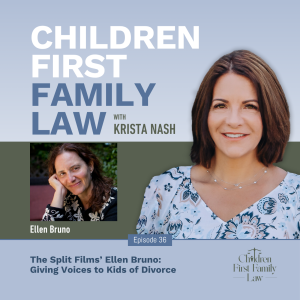
In this moving episode of the Children First Family Law Podcast, Krista welcomes acclaimed documentary filmmaker Ellen Bruno, the creator behind the powerful films “Split: The Early Years” and “Split Up: The Teen Years.” These documentaries feature a cast of real children who had experienced divorce of their parents, with purely their voices and artwork, no experts, no therapists, no adults – just the kids. Split featured the kids when young; Split Up then followed up with the same kids 10 years later, reflecting on how divorce had impacted them as they emerged into late teens and young adulthood. The films give incredibly powerful insight every parent going through family law dynamics should watch, as well as any professional in the family law arena. The film is raw, honest, and deeply impactful.
In her conversation with Krista, Ellen shares the personal journey that inspired her to create Split, which began after her own divorce when she heard her own child and others in carpools from school discussing issues of divorce and the lightbulb that went off in her head that she could use her filmmaking to give voice to the voiceless and shine a light on the impact of divorce on children She had already spent much of her career in humanitarian work and international filmmaking attempting to give voice to many different people groups, with films focusing on issues at the forefront of human rights.
Ellen began her relief efforts in remote Mayan villages in Tabasco, Mexico. She worked in refugee camps on the Thai-Cambodian border with the International Rescue Committee, in Vietnamese boat camps with The Refugee Section of the American Embassy in Thailand, and as director of the Cambodian Women's Project for the American Friends Service Committee.
With a masters degree in documentary film from Stanford University, she is a recipient of Guggenheim and Rockefeller Fellowships, a Goldie Award for Outstanding Artist, an Alpert Award for the Arts,an Anonymous Was A Woman Award for the Arts, a Shenkin Fellowship from Yale University School of Art, and was an Artist-in- Residence at the Yerba Buena Center for the Arts, among many other accomplishments.
Krista and Ellen explore recurring themes from both Split films, including identity shifts, the emotional cost of “two homes,” and the unspoken pressure children feel to take care of their parents. They also highlight how parents, legal professionals, and mental health practitioners can utilize the films to gain a deeper understanding of the child’s perspective—and why it matters so much. Ellen shares, too, the potential for another film following up yet again with these now-adult kids and/or their parents, a possibility Krista encourages.
This conversation is a true gem for the podcast and a must-listen for divorcing parents, co-parents, attorneys, and anyone who works with families. It’s a powerful reminder that small choices can create lasting change and that truly listening to children can transform our approach to divorce.
In this episode, you will hear:
The emotional cost of silence and shame in divorce
Why kids need space to share their experiences without adult interference
The impact of small co-parenting gestures, like family photos or shared events
How the Split films help parents and professionals re-center on children
A reminder that divorce doesn’t end in six months—it’s a lifelong transition
Resources from this Episode
To purchase the “Split” films:
https://www.splitfilm.org/family-purchase-options/
https://www.splitfilm.org/
Contact Ellen Bruno: info@splitoutreachproject.org
www.childrenfirstfamilylaw.com
All states have different laws; be sure you are checking out your state laws specifically surrounding divorce. Krista is a licensed attorney in Colorado and Wyoming but is not providing through this podcast legal advice. Please be sure to seek independent legal counsel in your area for your specific situation.
Follow and Review:
We’d love for you to follow us if you haven’t yet. Click that purple '+' in the top right corner of your Apple Podcasts app. We’d love it even more if you could drop a review or 5-star rating over on Apple Podcasts. Simply select “Ratings and Reviews” and “Write a Review” then a quick line with your favorite part of the episode. It only takes a second and it helps spread the word about the podcast.
Episode Credits
If you like this podcast and are thinking of creating your own, consider talking to my producer, Emerald City Productions. They helped me grow and produce the podcast you are listening to right now. Find out more at https://emeraldcitypro.com Let them know we sent you.